The upcoming months in Gaza are projected to becess deaths

Jordan’s first aid dropout over the Rafah crossing had been badly hurt during the five month-old conflict between Israel and Hamas
The chief executive officer of Save the Children, one of the biggest nongovernmental aid organizations, said when she visited the Rafah crossing a month ago, fewer than 140 trucks were making it in every day — compared to an average of about 500 a day before the war.
The deputy permanent representative of Israel to the UN said his government was going to improve access at the main border crossing with Egypt and another crossing in Israel.
The UN is not involved in the ongoing conflict between Israel and the militant group Hamas in Gaza, which has prevented aid from entering the peninsula for more than a week.
“It’s incredibly difficult to get supplies to people where they need it and to do that safely and securely,” Soeripto said, adding that northern Gaza was particularly hard hit by lack of food and a crumbling medical system.
Aid convoys have been under fire for being denied access to people in need. Jens Laerke, an OCHA spokesman, said that humanitarian workers have been harassed or intimidated by Israeli forces.
Gaza is a densely populated territory with borders that are not under foreign military control. A population that had been weakened by five months of war has descended on famine due to Israel’s refusal to allow more aid.
On Thursday, Jordan dropped seven tons of supplies over northern Gaza — the first aid shipment to the area in about a month. The pallets were loaded with cardboard boxes containing rice, flour, sugar, tea and milk, along with sanitary napkins.
On Thursday, photographers were prevented from photographing a flag of another Arab country on one of the pallet because it was one of two countries participating in the airdrops that day. On the tarmac was a Qatari cargo plane that had intended to participate in an airdrop before it developed mechanical problems.
Airdrops are considered the last resort of food delivery by the aid community. But Jordan hopes that the tons of food it is dropping during the 5-month-old war in Gaza will save at least some lives.
On the tarmac at the King Abdullah IIair base near the city of Zarka there were pallets waiting to be loaded onto cargo planes for drops later in the day. The meals were similar to military meals that were ready to eat for a population with little fuel for cooking.
It was difficult to see where the parachute-equipped food flew over northern Gaza. The meticulously planned airdrops, conducted with Israeli approval, are still subject to unpredictability. The pallet that was blown across the border to Israel was one of the many that fell in northern Gaza.
Israel has barred foreign journalists from Gaza since the start of the war, except for rare instances when it has escorted them. It is very difficult to know what is happening on the ground by disrupting phone and internet service. At the same time, Israeli strikes have killed at least 122 local journalists and media workers in Gaza since October, according to U.N. reports.
In a statement, the U.K. foreign secretary called it “unacceptable” that only half of the trucks crossed into Gaza in February.
She said that a Save the Children staffer in Gaza reported that doctors were sending premature infants to die if they didn’t have incubators. At least six children have died so far from malnutrition or from eating animal feed, the only food available, according to aid groups.
Source: Aboard Jordan’s aid airdrop over Gaza, a last resort for relief to Palestinians there
Gaza’s humanitarian crisis: “Alast resort for relief to Palestinians there” by Ahmed al-Haraj Salem, a Palestinian journalist
The Israeli military searches every car for weapons that could be used by Hamas, which attacked Israel on October 7, killing 1,200 people. In response to the attack, Israel launched a military campaign in Gaza that has killed more than 30,000 civilians, according to Gaza’s health ministry.
A Palestinian journalist in Gaza posted on X that there were thousands of hungry Palestinians in the same area as the people who were killed on Thursday.
Israel denies that it is blocking aid but aid groups say Israel has presented so many obstacles to deliveries through the Rafah crossing from Egypt that the food shipments have slowed to a trickle.
Salem said that the crowd dispersed when they saw an Israeli tank. They came back and attacked the trucks after it retreated. He said that when the soldiers opened fire. Israel used tanks to protect a convoy of private contractors in an aid delivery effort.
Salem is like many people in Gaza, he walks a long time to find food for his family. Even for those with money, there is no food available to buy.
There are very few ambulances or hospitals in Gaza because most of the infrastructure has been damaged by Israeli strikes. Salem was taken to the hospital in a horse-drawn cart.
Israel acknowledged it had opened fire in self-defense, but said most of the dead would have been killed if they had been run over or trampled on by trucks.
Ahmed al-Haraj Salem was hit by a bullet in his leg while he was standing by a truck, and was currently being treated at a hospital in Gaza City. “I fell to the ground and there was another shot fired that hit my hand.”
Source: Aboard Jordan’s aid airdrop over Gaza, a last resort for relief to Palestinians there
Projections of a Future for Gaza: the Humanitarian Crisis in the Light of Global Warfare and the Bombing Campaigns in Israel
FLYING OVER NORTHERN GAZA STRIP — Seventeen-thousand feet in the air, Jordanian air force personnel are unhooking the chains to let pallets of wrapped cardboard boxes attached to parachutes roll out the cargo door.
The researchers caution that they’re not trying to predict the future. Paul Spiegel is the director of the Center of Humanitarian Health atHopkins University, and a study co-author. Rather, they’re projecting what would happen given a slew of assumptions about the human costs of war, he says, similar to how climate scientists project future warming under different carbon emissions scenarios.
Even if the talks are successful, the humanitarian crisis could cause another 11,000 deaths by August 6, which is more than the 29000 deaths recorded by the Gaza Ministry of Health last week. The death toll has gone over 30,000.
Igusa says they had to be careful about how they defined the scenarios. The team decided to base the scenarios on existing casualty data. The current death toll in Gaza is reported by the ministry of health but not all deaths are reported.
For six months of war comparable to the early stages, they took the average casualties from October 15 through January 15 and spun them forward over the next six months. They assumed that the fighting would be even more intense than it was during the worst month of the conflict, October 11 to November 10, when over 11,000 people died.
“Israeli forces could decide to flood the tunnels with sea water or indiscriminate bombing of densely populated areas,” he says. We don’t know what the scenarios will mean in terms of the armed groups’ actions.
The status quo and escalation scenarios give rise to non-violent deaths as there is greater chance of interrupted medical care and epidemics. But given the authors’ assumptions, ongoing violence would account for the bulk of those excess deaths, which could reach 66,720 under the status quo scenario and 85,750 under escalation.
The scope of these projections can be seen by looking at estimated trauma deaths from two of history’s most devastating bombing campaigns during World War II, with Allied bombs killing some 25,000 over two days in Dresden and Nazi attacks taking approximately 40,000 lives in London over eight months.
Source: ‘Excess deaths’ in Gaza for next 6 months projected in first-of-its-kind effort
Gaza’s conflict for next six months projected in first-of-its-kind effort: ‘Excess deaths’ in Gaza for next 6 months
This initial report is very much a first draft. They plan to change their projections over the next few months and incorporate new data, including measures of mental health.
“I hope we’ve made clear that there’s still going to be a lot of death if there’s a ceasefire,” says Spiegel, underlining the importance of getting adequate food, water and medical attention to where it’s needed as soon as possible. Right now, blockades, continued assaults and damaged roads are preventing that aid from reaching those who need it.
“These very quantitative, evidence-based efforts are valuable,” in forcing politicians and humanitarian agencies to confront the human cost of continued fighting, says Asi. That’s the first step, that’s all. They have to be coupled with advocacy and political action.”
It was necessary to create two extreme scenarios, a ceasefire and increase, as well as a status quo middle ground. To inform these assumptions, the researchers gathered up all the data they could from the conflict so far, filling in the gaps with information from past conflicts, as well as consultation with trauma doctors in Gaza.
Source: ‘Excess deaths’ in Gaza for next 6 months projected in first-of-its-kind effort
Exposure to Trauma in Gaza for Next 6 Months Projected in First-of-its-kind Effort: Jonathan Lambert, MD, FAO, CIO, Natural Resources and Public Health
Jonathan Lambert is a Washington, D.C.-based freelance journalist who covers science, health and policy. He has worked for several publications including Grid and Science News, NPR, Nature News, and the Dallas Morning News. He holds a Master’s degree in evolutionary biology from Cornell University. You may follow him on either X or bluesky.
To estimate the possible toll of an outbreak, the team combined existing data on baseline health status, malnutrition, sanitation and vaccination rates with models of infectious disease spread. Children are more vulnerable to infections and would be particularly hard hit by such an outbreak. More than half a million people are currently facing catastrophic levels of deprivation and starvation, according to the United Nations.
Poor sanitary conditions in shelters and overcrowded areas can lead to the spread of diseases like COVID in conflict zones. But “it’s very difficult to estimate when such outbreaks might occur,” says Spiegel, which is why the team included projections with and without epidemics.
The best- to worst-case scenarios for the war between Israel and Gaza were decided upon by the researchers. Given those scenarios, they projected how many people would die directly from trauma or indirectly from infectious disease, maternal and neonatal causes and non-communicable diseases, like cancer or diabetes.
The researchers expect 3,250 deaths due to traumatic injuries after fighting stops. The rest of the 6,550 to 11,580 deaths post-ceasefire come from nonviolent causes.
It is important to think about how the health-care system is changing in the future. A lot of the trauma doctors consulted for the study stated that the situation right now is dire. “If hospitals are functioning, a person with a head or chest wound might survive. But in the current situation, it’s likely that he or she will not.”
Source: ‘Excess deaths’ in Gaza for next 6 months projected in first-of-its-kind effort
Projecting The Cost of War: Towards A Rigorous Treatment of the Human Cost of Human Decisions in the United States and in the Middle East
“We wanted to define scenarios that were realistic and then based on those scenarios project what might happen, giving us some [upper and lower] bounds to work with,” says Tak Igusa, a civil engineer at Johns Hopkins University.
“I’ve been looking at the cost of war in order to calculate how much it will cost”, says Ball. “I’m never projecting tomorrow’s deaths, but I can imagine a whole new field coming from this [analysis]. We are always going to be doing this from here.
Other experts agree. “It’s a rigorous way of talking about the human cost of human decisions,” says Patrick Ball, director of research for the Human Rights Data Analysis Group, a nonprofit organization. He said that the type of projections that are speculative can be useful in clarifying the costs of military action, which can help guide humanitarian action.
“It shows that even if the bombing stops tomorrow, people will continue to die, not simply from the destruction of the health-care system but [loss of] access to food, water, vaccinations and shelter,” she says. “Even if the numbers aren’t perfect, putting this all together forces us to confront the true toll of what this means for the population there. We can’t say that we didn’t expect this.
“There’s no perfect, pre-established methodology for this kind of projecting,” says Yara Asi, a public health expert who studies the health impacts of war at the University of Central Florida and wasn’t involved in the analysis. She says that it’s innovative and valuable.
The chaos of war usually means that researchers wait until a conflict is over to pore over the data and reconstruct as complete a picture as they can of how many lives were lost and what took them.
An Israeli strike on the Emirati maternity hospital in Rafah, southern Gaza: a “terrifying” risk for pregnant women, newborns and health workers
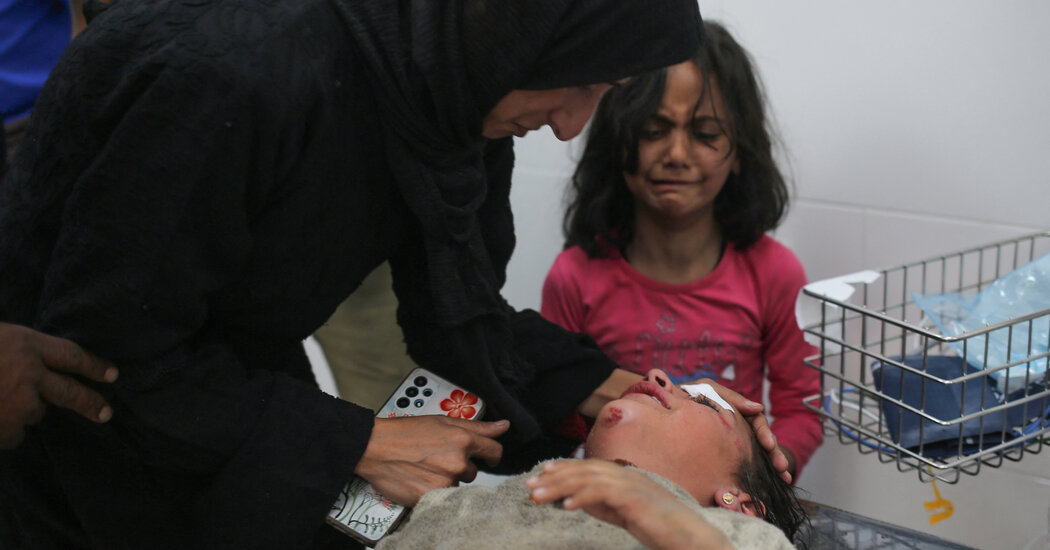
An Israeli strike outside a hospital in Rafah, in southern Gaza, on Saturday killed at least 11 people and injured dozens of other displaced Palestinians, including children, who were sheltering in tents nearby, the Gaza Health Ministry said.
There were at least two health care workers killed in the strike near the Emirati maternity hospital, according to the health ministry.
The health ministry identified the paramedic as Abdul Fattah Abu Marai, and the news agencies took photos of his colleagues taking his body to the hospital.
The Israeli army had previously declared that Rafah would be a safe area for civilians, and now there are more than fifty percent of the population crammed into it.
Even as the number of people being housed in Rafah has increased, the number of strikes on the town has not. Despite warnings from humanitarian groups that any military operation in Rafah would have disastrous consequences for civilians, the prime minister of Israel said he would go ahead with his forces entering the city regardless of the cease-fire deal.
The news of Saturday’s strike was “outrageous and unspeakable,” the leader of the World Health Organization, Tedros Adhanom Ghebreyesus, said on social media, reiterating calls for a cease-fire and for the protection of health care workers and civilians.
The Emirati hospital is essentially “the last hope for pregnant women in the whole of Gaza,” Mr. Allen said. A strike so close to the hospital poses a “terrifying” risk to pregnant women, newborns and the overloaded health care workers trying to care for them, he added.
Israel has carried out its first airstrikes in Gaza since the beginning of the conflict between the militant group Hamas and the country’s military. The strikes, which have killed at least 11 people, targeted a maternity hospital in the city of Rafah, the Palestinian Health Ministry said. Over 38,000 people have been killed in the conflict, according to Gaza’s health ministry.